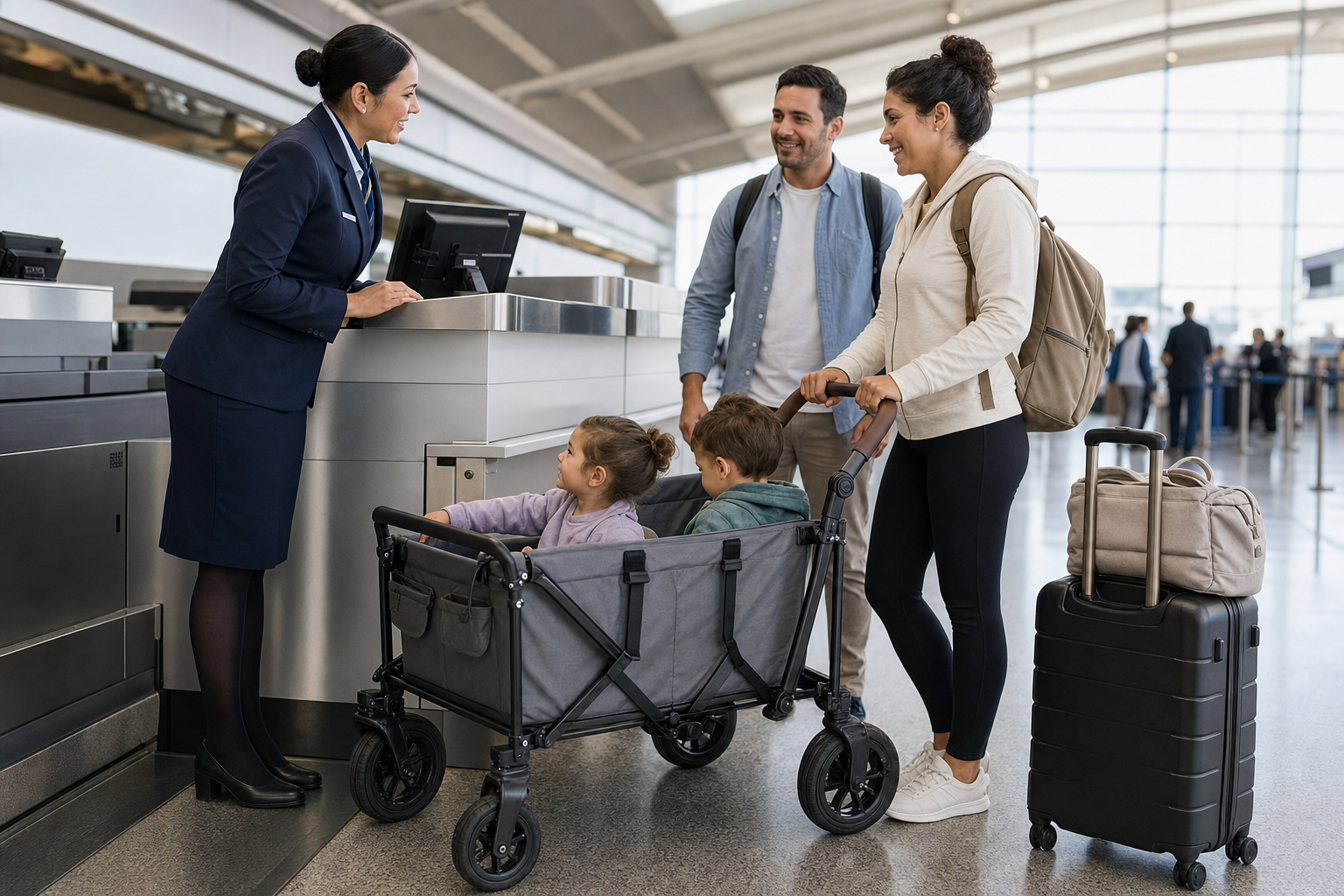
Can you gate check a stroller wagon? Often, but not automatically. United States law generally prevents an airline from refusing a passenger’s request to gate check a stroller used to transport a child travelling on the same flight, unless the stroller’s size or weight creates a safety or security risk. The law does not specifically define a “stroller wagon,” however. Whether a particular wagon is treated as a stroller depends on the operating airline’s policy and the item’s design, size and ability to fold.
A child-carrying wagon with built-in seats and safety restraints has the strongest case. A utility wagon for cargo is more likely to be treated as ordinary checked baggage, which can mean handing it over at the ticket counter and paying any applicable bag fees. The policies in this article were checked on September 18, 2026; confirm the rule for your operating airline before travel.
How airlines distinguish stroller wagons from ordinary wagons
The product’s design matters more than the name used by its owner or retailer. Airline staff may consider its intended use, child restraints, folded size, weight and whether it can be safely handled at the gate.
- Conventional stroller: A pushchair designed to carry a child, usually with a seat, harness, brakes and folding frame. This is the category clearly covered by the federal gate-check rule.
- Child-carrying stroller wagon: A push-or-pull wagon designed for children and fitted with seats or built-in child safety restraints. Some airlines expressly include qualifying folding stroller wagons in their free child-item allowance.
- Utility wagon: A cargo wagon intended mainly for luggage, groceries, sports equipment or beach supplies. It is likely to be treated as a normal checked bag, even if a child sometimes rides in it.
A collapsible frame alone does not make a utility wagon a stroller. Equally, a child-carrying wagon may need to be checked at the ticket counter if it is unusually large, heavy or non-folding. Keep in mind that gate checking means the item is accepted near boarding; it does not mean it will travel in the cabin or be returned at the aircraft door.
Published policies from major US airlines
These examples show why checking the exact airline policy matters. Airlines that use the word “wagon” can draw their own distinctions between a child-carrying stroller wagon and a general-purpose wagon.
| Airline | Published treatment | Practical takeaway |
|---|---|---|
| Alaska Airlines | Its free stroller and car-seat policy also applies to stroller wagons designed to carry children that collapse to under 90 linear inches and weigh under 35 pounds. | A qualifying stroller wagon may be checked free with baggage or at the gate. Standard baggage rules apply to larger wagons, wagons not designed for children and extra wagons carried in addition to a stroller. |
| American Airlines | Each ticketed customer travelling with a child may check one stroller and one car seat free. Non-collapsible strollers and stroller wagons without built-in child safety straps must be checked at the ticket counter; other strollers should be checked at the gate. | A folding wagon with built-in child restraints is more likely to be accepted for gate checking. A wagon without built-in straps is treated as a regular bag and can incur normal charges. |
| Delta Air Lines | Delta allows strollers and child-restraint seats to be checked free at the counter or gate, but specifically says that wagons count toward the checked-baggage allowance and should be checked before security. | Do not rely on Delta’s stroller allowance for a stroller wagon. Plan to check a wagon before security and expect the normal baggage allowance and fees to apply. |
Other airlines may publish a general stroller rule without expressly addressing wagons. In that situation, contact the airline before departure with the product name, folded dimensions, weight and photographs of its child seats and restraints. Ask whether it may be taken through security and checked at the departure gate.
Fees follow the item’s classification. A stroller or qualifying child-carrying stroller wagon accepted under a carrier’s child-item policy is generally free. An ordinary wagon can count against the checked-bag allowance and may be subject to standard, overweight or oversized-baggage charges. For a related child-travel rule, see Do Car Seats Count as Checked Baggage on US Airlines.
Prepare the wagon before leaving for the airport
Measure and weigh the wagon at home when it is fully folded, including removable wheels or accessories if they remain attached. Linear size means the total of length, width and height. Save the airline policy and the manufacturer’s product page showing that the model is designed to transport children and includes built-in restraints.
- Practise folding it. You may need to collapse it quickly at the gate while managing your child and carry-on items.
- Remove loose accessories. Detach snack trays, cup holders, canopies, rain covers, parent consoles and removable storage where practical. Pack them in your luggage or secure them in the wagon’s travel bag.
- Empty every pocket. Remove toys, bottles, clothing and electronics before screening and before handing the wagon to airline staff.
- Label the wagon. Add your name, phone number and destination inside and outside any protective bag.
- Use a protective bag if practical. It can help keep the item clean and reduce the chance of snagged accessories, but it does not guarantee protection from damage during handling.
Photograph the wagon before checking it, including wheels, hinges, handle and fabric. Inspect it as soon as it is returned. If it is damaged or missing, report the problem to the airline’s baggage staff before leaving the airport where possible, and retain your baggage tag and boarding pass.
At the Transportation Security Administration checkpoint, remove the child and empty the wagon. Screening arrangements vary by checkpoint and equipment size: a folded wagon may go through the X-ray machine, while a larger item may need separate screening. Allow extra time and follow the officer’s instructions.
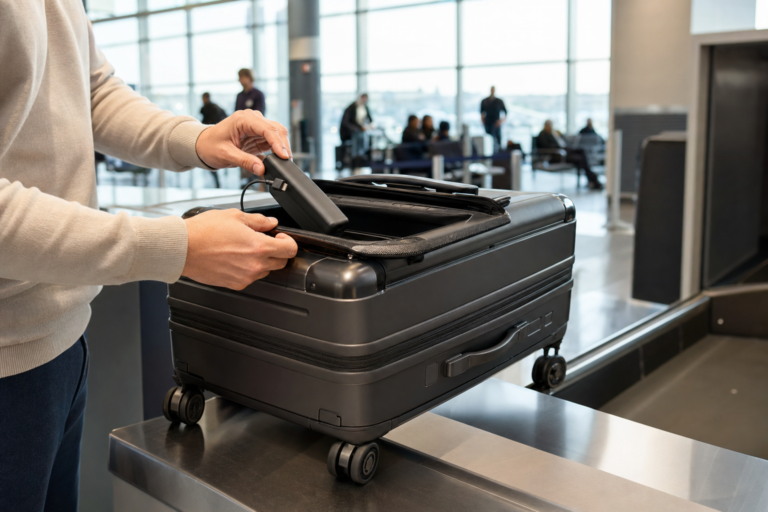
If the wagon has a battery, check its manufacturer information and your airline’s hazardous-materials policy well before departure. Spare lithium batteries and power banks must stay in the cabin and their terminals must be protected from short circuit. Lithium-ion batteries from 101 to 160 watt-hours require airline approval, while batteries above 160 watt-hours are generally prohibited on passenger aircraft. Do not travel with a damaged or recalled battery unless it has been made safe in line with applicable instructions.
What to do at the gate and on connections
At check-in, tell the agent that you have a child-carrying stroller wagon and ask whether it may be used through the airport. If the answer is yes, speak with the gate agent well before boarding to obtain the correct tag and confirm where to leave it: at the gate, jet-bridge door, aircraft stairs or a marked collection point.
Ask where the wagon will be returned after landing. Depending on the airline, airport, aircraft and tag, a gate-checked item may be delivered on the jet bridge, beside the aircraft, at the regular baggage carousel or in an oversized-baggage area. Do not assume that “gate checked” means “returned at the gate.”
For a connection, read the destination printed on the tag. If the airline returns the wagon at the connection, you will need to take it through the terminal and hand it over again before the next flight. If it is tagged through, you may not see it until the final destination. Policies can also differ on a codeshare or partner-operated flight, so check every operating carrier rather than relying on the airline that sold the ticket.
If an employee classifies the wagon as ordinary baggage, politely show the current airline rule and the manufacturer’s evidence that it is designed to carry children. Point out built-in restraints if the airline policy makes them relevant. If the published policy clearly covers the item, ask for a supervisor calmly and early enough that the issue does not delay boarding.
If the policy is silent or excludes the wagon, staff can require counter check-in and standard baggage treatment. Keep a baby carrier or another workable backup plan so that a classification decision does not leave you without a safe way to manage your child in the terminal.