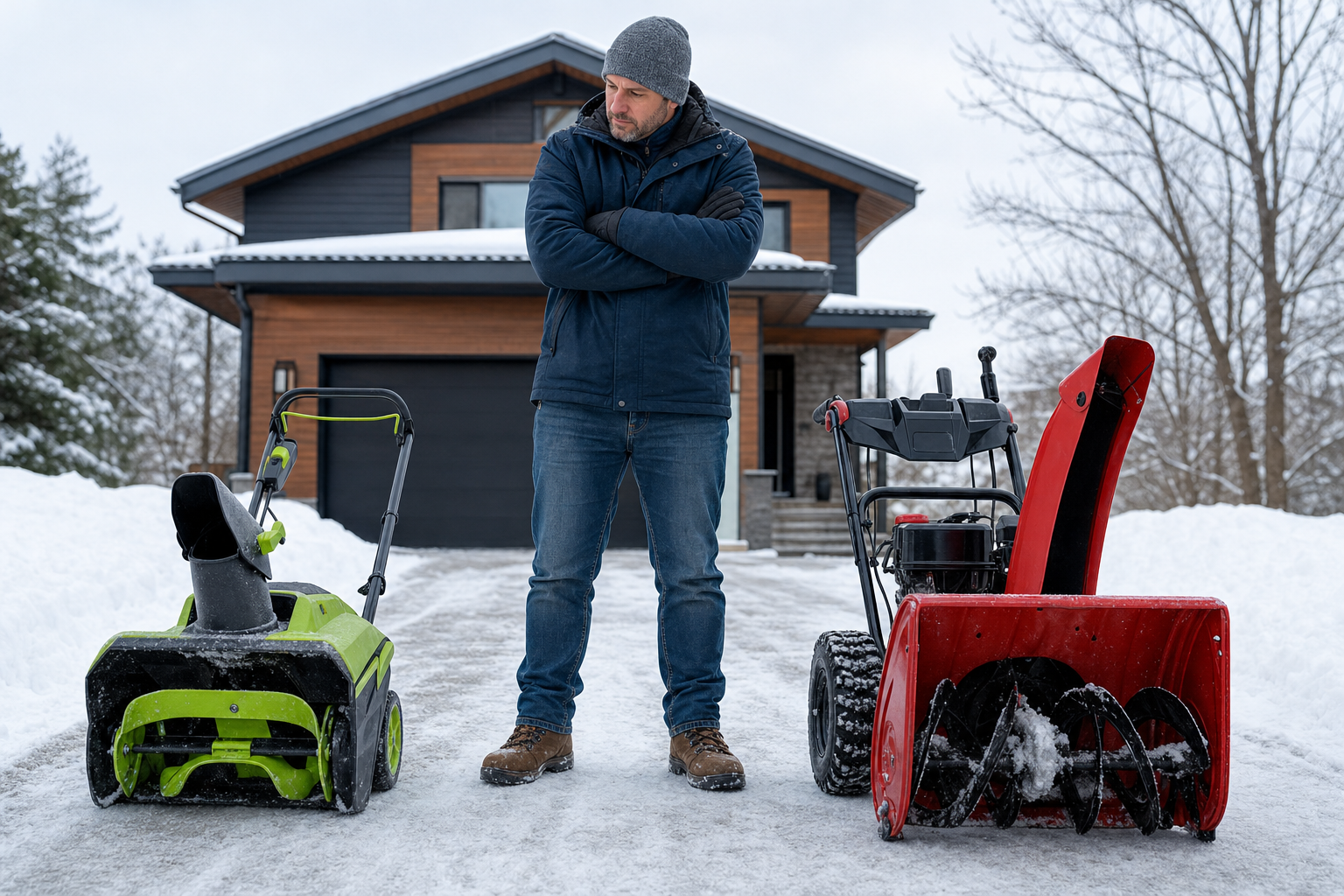
Choose a battery snow blower if its supplied batteries can comfortably clear your entire property in difficult snow and you value quieter operation, easy starting and reduced engine maintenance. Choose gas if you regularly face long clearing sessions, repeated work during major storms or several properties and need to resume quickly by refuelling. In either case, buy for your heaviest normal snowfall and the dense ridge left by a street plow, not for an average dusting.
Match the snow blower to your hardest clearing job
Start with the property and snow conditions rather than the power source. Measure the driveway and walkways, note slopes and tight turns, and consider whether you will help a neighbour. The machine must also handle the compacted, wet snow that plows deposit at the end of a driveway.
Manufacturer estimates expressed as parking spaces, driveway area or clearing time can be useful for comparing models within a product line, but they are not guarantees. Results depend on snow depth and density, battery capacity, temperature, travel speed, overlapping passes and how often you use powered drive or high-speed auger settings.
| Property and conditions | Likely starting point | Features to prioritize |
|---|---|---|
| Small paved driveway and short walkways with mostly light snow | Battery single-stage | Low weight, compact storage, adequate included batteries and a suitable charger |
| Typical suburban property with moderate storms | Capable battery single-stage, battery two-stage or gas single-stage | Plow-ridge performance, manoeuvrability and enough energy or fuel to finish |
| Long, sloped or gravel driveway | Battery or gas two-stage | Traction, adjustable clearing height, suitable tires or tracks and practical runtime |
| Regular deep or wet snow and substantial plow ridges | Heavy-duty battery or gas two-stage | Intake height, sustained capacity, driven traction and convenient chute controls |
A single-stage machine uses a rotor or auger to collect and throw snow in one operation. These machines are usually lighter and easier to turn, making them convenient on smooth paved surfaces. However, some models are unsuitable for gravel because their paddles or rotor operate close to the ground. The Toro 21-inch Power Clear Flex-Force model, for example, is specifically described as unsuitable for clearing gravel surfaces. Always check the manual for the exact model.
A two-stage machine uses an auger to feed snow into a separate impeller. Many models have self-propelled wheels or tracks and adjustable skid shoes, but these features are not universal. Confirm them in the specifications rather than assuming that every two-stage machine includes them.
For a model equipped with adjustable skid shoes, follow its manual closely when setting it up for gravel. The terminology can be confusing: on the Ariens procedure cited below, you place the specified spacers under the scraper bar, loosen the skid shoes and lower the skid shoes until they contact the surface. This raises the auger housing and scraper bar farther above the gravel. Greater clearance reduces the chance of collecting and throwing stones, although it normally leaves a thin layer of snow behind.
If stage selection is your main concern, see Single Stage or Two Stage Snow Blower for Your Driveway.
Compare battery runtime with gas refuelling
A capable battery snow blower can handle substantial work, but only if the batteries in the package provide enough usable energy for your conditions. Check exactly what is included because some machines are sold without batteries or a charger, while similarly named kits may include one or more battery packs.
Battery capacity is commonly listed in amp-hours. Watt-hours can be more informative when comparing energy capacity, particularly within the same battery system, but neither figure guarantees a particular clearing time. Wet snow, deep drifts, cold battery packs, aggressive travel speed, powered traction and frequent use of maximum output can all shorten runtime.
Estimate how long your worst realistic clearing session takes, then allow a margin for the plow ridge and unusually heavy snow. If the supplied batteries appear marginal, include the price of a spare charged set when comparing the total purchase cost. Also check the charger’s stated charging time. A larger battery may last longer but can take considerably longer to recharge with a basic charger.
Gas is convenient for prolonged or repeated work because adding fuel takes much less time than recharging a depleted battery. That advantage can matter on a long rural driveway, during a storm that requires several passes or when clearing multiple properties. It comes with extra responsibilities: fuel must be stored safely, added outdoors before starting and never poured into a hot or running engine.
Battery models remove the need to buy and handle gasoline and generally start by pressing a button or operating a lever. Their electric motors also avoid gasoline-engine exhaust and much of the engine noise, although the rotor, auger and impeller still create sound. Gas machines can provide strong sustained performance without maintaining a collection of expensive batteries, but they require seasonal engine care and safe fuel storage.
Consider maintenance, storage and lifetime costs
Battery snow blowers avoid oil changes, spark-plug service and fuel-system maintenance. They are not maintenance-free. Owners still need to remove accumulated snow and salt, inspect the scraper and rotor or auger, check fasteners, examine the chute and replace worn paddles, belts, scraper bars or shear pins as applicable. Remove the battery and starting key or button before cleaning, adjustment or storage.
Gas snow blowers need the same attention to wear items plus engine maintenance. Depending on the model, that may include checking and changing oil, servicing the spark plug, maintaining belts and drive components, and stabilising or draining fuel before seasonal storage. Follow the machine and engine manuals because maintenance requirements vary.
- Battery cost: Compare complete kits rather than bare-tool prices. Replacement packs can be a major expense, especially for a two-stage machine that uses several high-capacity batteries.
- Shared platforms: Batteries that also operate a compatible mower, leaf blower or other useful equipment may provide better overall value.
- Gas cost: Budget for fuel, oil, stabiliser, service parts and possible engine repairs over the machine’s life.
- Parts and support: Check warranty terms and local availability of batteries, chargers, belts, paddles, scraper bars and shear pins before buying.
Storage space depends mainly on the machine’s physical size. A folding single-stage battery model may fit in a small garage, while a large battery two-stage model can occupy about as much floor space as its gas counterpart. A gas machine also needs a safe fuel-storage arrangement. Never run a gasoline snow blower in a garage, shed or other enclosed area because carbon monoxide can accumulate and kill without warning.
For a small patio, deck or short paved path, a full walk-behind machine may be unnecessary. This comparison of an electric snow shovel and snow blower explains the lighter-duty alternatives.
Charge batteries and clear clogs safely
Charge lithium-ion batteries only with the specified charger and within the temperature range stated by the battery manufacturer. Use a dry, suitable, well-ventilated indoor location, such as an appropriate garage area, rather than assuming an unheated shed is safe for charging. Keep the charger away from moisture, blocked vents, combustible clutter and areas accessible to children.
Temperature limits vary by battery platform. For example, Toro specifies a charging range of 41°F to 104°F for the battery associated with the Power Clear model cited below. Its instructions call for an enclosed, clean and dry storage area and warn against outdoor or vehicle storage. Another manufacturer or battery pack may specify different charging, operating and storage temperatures, so use the exact manual supplied with your equipment.
After clearing, remove the battery before cleaning or storing the machine and keep the pack away from de-icing salts and other corrosive materials. Follow the manufacturer’s off-season charge guidance. Some battery systems should not be stored fully charged or fully depleted, but that instruction is not universal.
If the discharge chute or auger clogs, stop the machine and wait for every moving part to stop. On a battery model, remove the battery and starting key or button as directed. On a gas model, shut off the engine and follow the manual’s disabling procedure. Use the supplied cleanout tool or another appropriate long tool. Never place your hands in the chute or near the auger, even after the power source has been switched off.
The better choice is therefore the model that completes your hardest routine job with a comfortable reserve. Battery is particularly appealing when one charged set can finish the property. Gas remains practical when rapid refuelling and extended operation outweigh the additional noise, fuel handling and engine maintenance.